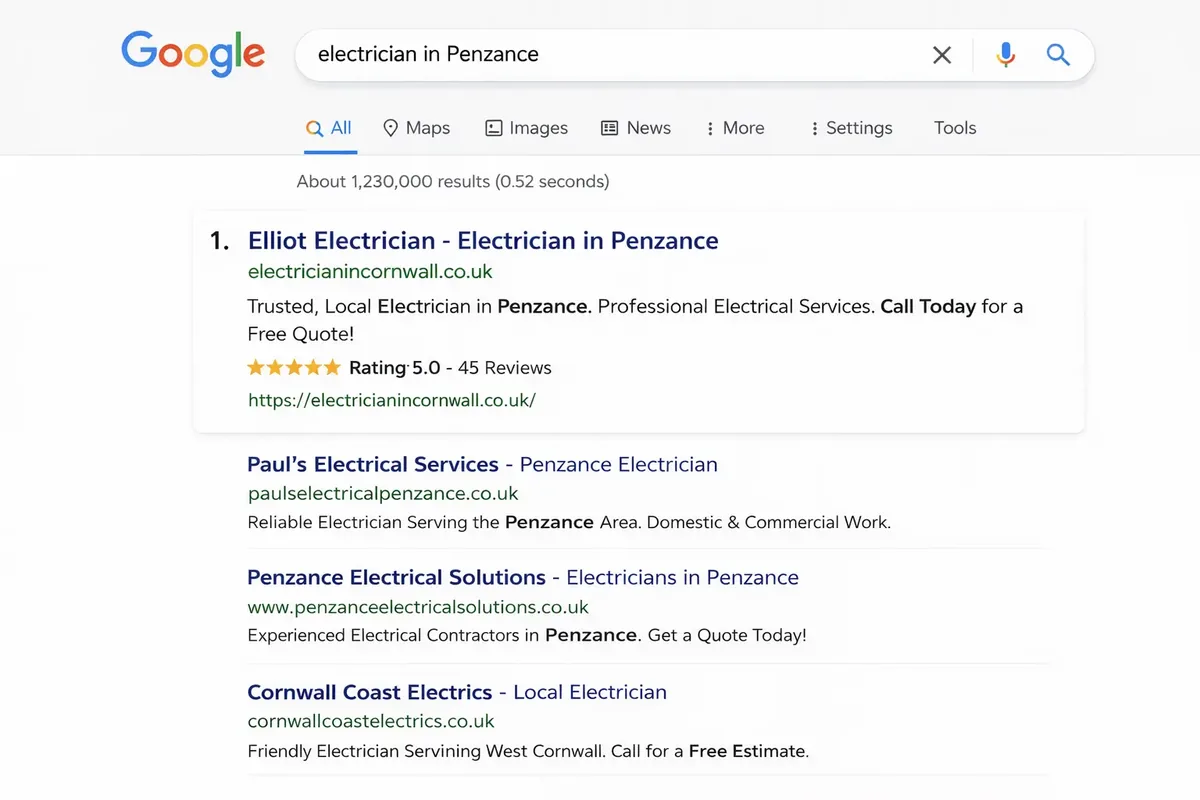
When someone searches for an electrician, plumber, roofer or builder nearby, Google has to decide which businesses are relevant to the job and useful to the person searching. There is no switch that places a company first overnight. Strong local visibility is built by keeping your business information accurate, showing genuine local relevance and earning trust over time.
Understand how Google approaches local results
Google says local results are mainly based on three factors: relevance, distance and prominence. Relevance is how closely your business matches the search. Distance is how far the business is from the searcher or the location named in the search. Prominence reflects how well known and well supported the business appears to be.
You cannot control every factor. You cannot move your business closer to every searcher, and Google does not sell a better organic local ranking. You can make your services clearer, keep your information complete and build stronger evidence that your business is active and trusted.
Google explicitly states that there is no way to request or pay for a better local ranking.
1. Complete and verify your Google Business Profile
Your Google Business Profile is one of the clearest sources of information about your business. Claim and verify it, then complete every relevant section accurately. Use your real business name rather than adding locations or services that are not part of the name.
Pay particular attention to:
- The most accurate primary business category.
- Relevant secondary categories without choosing unrelated options.
- Your phone number, website, hours and service area.
- A concise description of the work you genuinely provide.
- Your individual services and helpful photographs.
Update the profile when hours, contact information or services change. Complete information helps Google understand the business and prevents customers from reaching an old number or incorrect opening time.
2. Build website pages around real services
Your website can explain your work in more depth than a business profile. Give each important service enough space to answer the questions a customer would ask. An electrician might need separate useful information for rewires, consumer unit upgrades, fault finding and commercial work. A roofer might cover repairs, flat roofing, pitched roofing and inspections.
Do not create dozens of near-identical pages with only the town name changed. A location page should be useful in its own right, reflect an area you genuinely serve and contain specific information or evidence relevant to customers there.
3. Keep your business details consistent
Your name, phone number, address or service-area information should agree across your website, Google Business Profile and established directories. Small formatting differences are normal, but old phone numbers, duplicate profiles and contradictory addresses create confusion for customers and search engines.
Put your key details somewhere easy to find on the website, normally the contact page and footer. If you operate from a service area and do not receive customers at an address, represent that honestly rather than displaying a location customers cannot visit.
4. Ask for genuine reviews and respond to them
Reviews help customers judge whether a business is dependable. Google also identifies review count and positive ratings as factors that can contribute to local prominence. Ask satisfied customers for an honest review soon after completing the work, when the experience is still fresh.
Do not buy reviews, offer incentives that distort them or ask staff and family to pose as customers. Respond professionally to both positive and negative feedback. A calm, useful response often tells a future customer as much about the business as the original review.
5. Add useful photographs
Use genuine photographs of completed jobs, your team, branded vehicles and the way you leave a property. These images help a customer recognise the business and judge the quality of the work. Add descriptive context on the website rather than uploading hundreds of unexplained images.
Keep your strongest recent images on your Google Business Profile as well. Remove outdated photographs when they no longer represent the services or branding accurately.
6. Make the website fast and easy to use on mobile
A customer searching locally may be using one hand on a phone while dealing with an urgent problem. Make the phone number easy to tap, keep enquiry forms short and put the main service and coverage information near the top of the page.
Compress large images, avoid unnecessary scripts and test important pages on a real phone. Speed does not replace useful content or a strong reputation, but a slow page can lose the customer after you have done the difficult work of being discovered.
7. Build prominence honestly
Google explains that prominence can include information it finds around the web, including links and articles. For a trade business, useful opportunities may include memberships, manufacturer listings, local sponsorships, trade associations and genuine coverage from local organisations.
Focus on relationships that make sense for the business. Paying for hundreds of low-quality directory links or exchanging unrelated links rarely helps customers and can create more cleanup than value.
8. Measure enquiries, not only positions
Rankings vary by location, device and search wording. Track the outcomes that matter: qualified calls, messages, quote forms and the services people ask about. Google Business Profile performance data and website analytics can show which searches and pages are producing useful activity.
This also prevents wasted effort. A page might attract many visitors but no suitable jobs, while a smaller service page may consistently bring high-value enquiries.
A practical 30-day starting plan
- Claim, verify and fully review your Google Business Profile.
- Correct your phone, hours, website link and service areas everywhere important.
- Choose the three to five services you most want to be found for.
- Create or improve a genuinely useful page for each main service.
- Add recent job photographs, credentials and customer proof.
- Ask recent satisfied customers for honest Google reviews.
- Test the complete search-to-call journey on a mobile phone.
- Record where new enquiries heard about you and which service they need.
Consistency beats quick tricks
Sustainable local visibility comes from accurately representing the same reliable business everywhere a customer encounters it. Keep the profile current, publish useful service information, collect genuine evidence and make the route to contact simple. Those actions help Google understand the business and help customers feel confident choosing it.
Source: Google Business Profile Help: Tips to improve your local ranking.